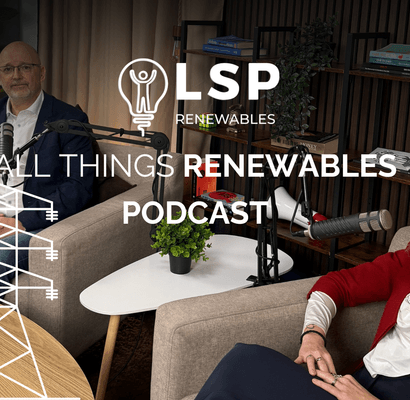
Delivering Britain’s electricity grid upgrade requires coordinated investment in infrastructure, faster connections, digital innovation and a skilled workforce. In the latest episode of All Things Renewables, LSP Renewables’ Martin Pace joins Abbie Badcock-Broe to explore how these challenges connect and what they mean for the road to 2030 and beyond.
Drawing on around 20 years of experience across the energy sector, including strategy roles within the Electricity System Operator and National Grid, Abbie shares her perspective on the decisions shaping Britain’s future energy system.
The conversation explores why connection reform alone cannot solve infrastructure constraints, how data centres could contribute to a more flexible network, and why workforce planning needs to sit alongside project planning.
What is NESO’s role in the energy transition?
The National Energy System Operator (NESO) brings together electricity system operation, strategic energy planning and independent advice to government and the regulator. Established under public ownership in October 2024, it has a wider remit than its predecessor, the Electricity System Operator (ESO).
Abbie explains that this whole-system perspective is essential to coordinating electricity, gas and the future role of hydrogen. Decisions about where energy is generated need to connect with where it will be consumed and the infrastructure required to move it.
For developers, network operators and investors, this means individual projects form part of a much wider planning challenge. The location, timing and purpose of investment all matter.
Why grid connection reform needs more than a shorter queue
Grid connection reform aims to prioritise projects that are ready to progress and needed by the energy system, replacing the historic “first come, first served” approach.
In the podcast, Abbie explores the legacy behind the connections challenge. Speculative development, competing project portfolios and the pace of renewable energy growth have created a complex pipeline.
However, reorganising that pipeline does not automatically create the physical capacity to connect projects.
Abbie highlights system access as another practical constraint. Connection works must be scheduled safely around the operation of the existing electricity network, alongside maintenance and other infrastructure requirements.
For businesses developing energy projects, the implication is clear: connection readiness needs to account for commercial commitments, construction progress, network capacity and the practical work required to connect safely.
How data centres are changing electricity demand
The growth of data centres adds another dimension to grid planning. Alongside connecting new renewable generation, the energy system must accommodate changing patterns of electricity consumption.
Abbie highlights a mismatch between the speed at which data centres can be developed and the longer timescales associated with major transmission infrastructure.
This raises questions about how large electricity users can work more closely with network operators. In the discussion, potential approaches include:
-
Sharing connections and substation infrastructure.
-
Increasing electricity demand gradually through ramped connections.
-
Exploring flexibility services that adjust consumption to support the network.
-
Considering locations that better align demand with available generation and capacity.
Abbie also challenges the assumption that flexibility only means reducing demand. Where operationally feasible, increasing consumption when renewable generation is available could help make better use of that electricity.
The opportunity is to consider how new demand can support the wider energy system as well as draw power from it.
Digital innovation must move from individual trials to wider use
Abbie’s perspective on innovation is that the sector has ideas, but needs to increase their impact at scale.
She discusses her involvement in the ESO’s Virtual Energy System initiative, which explored connecting digital twins across the energy system. A digital twin is a digital representation of a physical asset or system, helping organisations model scenarios and understand how changes could affect performance.
The conversation also examines the role of better-quality data, artificial intelligence and information sharing.
For Abbie, the challenge extends beyond developing technology. Organisations need to collaborate, establish appropriate governance and find ways to share information that benefit the wider system.
Engineering innovation also has a role in making better use of existing infrastructure. She points to dynamic line rating as an example of an approach that can help increase the usable capacity of electricity networks under suitable operating conditions.
Which skills are needed to deliver the grid upgrade?
Infrastructure investment needs people with the capabilities to deliver it. Abbie identifies electrical, civil and mechanical engineering as core requirements across construction, operation and maintenance.
She also highlights the importance of an ageing workforce passing knowledge to the next generation. Building specialist capability takes time, making strategic workforce planning an essential part of delivery.
Alongside technical expertise, the discussion identifies several broader capabilities:
-
Systems thinking: understanding how decisions affect other parts of the energy system.
-
Creative problem-solving: finding different approaches to complex delivery challenges.
-
Digital and data skills: supporting modelling, analysis and technology adoption.
-
Collaboration: bringing together organisations with different responsibilities and expertise.
-
Strategic thinking: connecting immediate project needs with longer-term infrastructure plans.
As Abbie explains:
“There is also no one single player that can solve all of this.”
For employers, the discussion reinforces the value of identifying skills requirements early, protecting specialist knowledge and planning recruitment alongside training and development.
Looking beyond 2030
While 2030 provides an immediate focus, Abbie encourages the industry to consider the much longer life of energy infrastructure.
Assets being planned today will serve communities and businesses for decades. Success therefore involves making progress towards near-term goals while protecting the resilience and usefulness of the future energy system.
Her message is to maintain momentum, apply lessons as projects progress and keep improving how infrastructure is delivered. Policy certainty, collaboration and a clear explanation of the benefits to consumers all have a part to play.
Connecting energy projects with the people to deliver them
At LSP Renewables, conversations with industry leaders help us understand the challenges shaping recruitment across renewable energy, grid and transmission and distribution.
This episode highlights why workforce planning belongs within the wider delivery conversation. As infrastructure programmes develop, businesses need to understand which capabilities they require, when they need them and how they will build sustainable teams.
Planning your next grid or renewable energy project? Contact hello@lsprenewables.com to discuss your recruitment and workforce requirements.
Watch or listen to the full All Things Renewables episode, The Great Grid Upgrade: Powering the Road to 2030, for the complete conversation with Abbie Badcock-Broe.