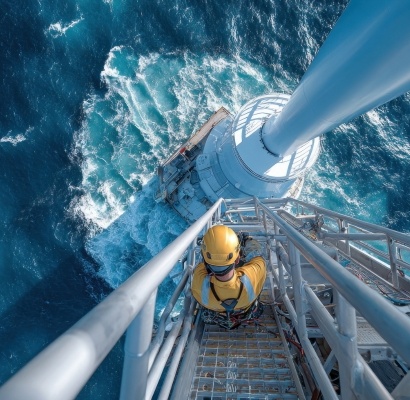
Wind Turbine Technician Recruitment in the UK
UK offshore wind direct and indirect employment is scaling from circa 26,000 to roughly 69,000 by 2026, with wind turbine technicians the highest-volume hiring discipline. The Global Wind Workforce Outlook forecasts a 6-8% global shortage by 2028 and 532,000 technicians needed worldwide.
Key Takeaways
- UK offshore wind employment is scaling from circa 26,000 to 69,000 by 2026, with the Humber cluster mapped to grow from 1,700 to 10,500 (Global Wind Workforce Outlook, 2026; Greater Lincolnshire LEP, 2025).
- The global wind sector faces a 6-8% workforce shortage by 2028, requiring over 532,000 technicians worldwide, with 40% as new entrants (Global Wind Workforce Outlook, 2024).
- Newly trained wind turbine technicians earn around £20,000; experienced technicians £40,000+; senior-level wind turbine engineers £80,000+ (Wind Jobs UK, 2026).
- Offshore wind technicians on contract day rates run £240-£340/day on inspection scope, with experienced GWO-certified offshore O&M technicians higher.
- GWO Basic Safety Training, offshore medical and sea survival are non-negotiable gates for any vessel or turbine-facing scope.
What a Wind Turbine Technician Actually Does
Wind turbine technicians maintain and repair turbines to maximise operational uptime. The role runs across onshore and offshore O&M, with scheduled and reactive maintenance, fault-finding, mechanical and electrical repair, and inspection scope. The certification stack is GWO Basic Safety Training, offshore medical and sea survival for offshore work, plus manufacturer-specific platform certification (Vestas, Siemens Gamesa, GE, Nordex, Enercon).
The 2026 UK demand splits across three discipline lines. Onshore O&M technicians, based at developer or OEM service hubs across the UK. Offshore O&M technicians, working SOV and CTV-based rotations from Lowestoft, Grimsby, Aberdeen and the wider port network. Inspection technicians, running blade, structural and safety-equipment inspections on a project-by-project basis.
The market is candidate-driven at every level. The Humber cluster alone is mapped to grow from 1,700 to 10,500 workers (Greater Lincolnshire LEP, 2025). The dynamic feeds into the wider renewable energy specialist hiring picture in 2026, where senior-tier roles compete for talent against the same finite delivery pool.
What's the difference between an onshore and offshore wind turbine technician?
Offshore technicians work SOV and CTV-based rotations with full GWO certification, offshore medical and sea survival, earning premium day rates for vessel time. Onshore technicians work from regional service hubs on day-based rotations, with less stringent safety certification but the same platform-specific manufacturer training. Offshore roles typically pay 30-50% more on equivalent experience.
What Wind Turbine Technicians Earn in 2026
Newly trained wind turbine technicians earn around £20,000 entry-level, rising to £40,000+ with experience (Wind Jobs UK, 2026). Senior-level wind turbine engineers exceed £80,000. Offshore technicians earn 30-50% more on equivalent experience, with rotational allowances, offshore medical insurance and GWO refresher coverage. Self-employed wind turbine engineers define their day rates, with inspection technicians at £240-£340/day on UK offshore sites.
The Astute People 2025 Renewable Energy Salary Guide reported 61% of clean-energy firms raised salaries every year since 2023. Technician pay tracks the wider sector inflation, with offshore O&M and inspection roles tracking the upper band. The full discipline picture overlaps with the broader essential skills brief for renewable energy careers, which maps the certification stack against current market demand.
How much does an offshore wind turbine technician earn in 2026?
Offshore wind turbine technicians earn 30-50% more than onshore equivalents, with mid-career offshore O&M technicians typically £45,000-£60,000 plus rotational allowances and offshore medical insurance. Senior offshore technicians and team leaders earn £55,000-£75,000. Contract inspection technicians run £240-£340/day on UK offshore sites depending on platform experience and GWO certification.
The 3 Biggest Obstacles on a Wind Turbine Technician Brief
Three obstacles recur on 2026 wind turbine technician hires.
The 6-8% global workforce shortage. The Global Wind Workforce Outlook forecasts a global shortage of skilled wind technicians by 2028, requiring 532,000 worldwide with 40% as new entrants. UK demand sits inside this global contest, with developers and OEMs chasing the same finite pool.
GWO certification expiry and refresher logistics. GWO Basic Safety Training requires biennial refresher; offshore medical requires annual renewal; sea survival is biennial. A specialist desk tracks certification expiry across the placed pool, not just the certificate-at-placement snapshot.
Cross-sector competition with oil-and-gas, marine and rail. Wind turbine technicians draw laterally from offshore oil-and-gas, marine engineering, rail and military backgrounds, with the 60% offshore O&G skills overlap accelerating the transfer corridor.
Why is GWO certification so important for offshore wind technician hiring?
GWO Basic Safety Training, offshore medical and sea survival are non-negotiable gates for any vessel or turbine-facing scope on a UK offshore wind project. Without current certification, a technician cannot board a CTV or access a turbine nacelle. Specialist desks pre-check certification expiry, not just initial qualification, before shortlisting. A GWO refresher gap is the single most common cause of mobilisation lag at technician level.
How We Hire Wind Turbine Technicians
Four steps close the wind turbine technician brief on schedule.
Step 1: We brief into the platform and scope. Vestas, Siemens Gamesa, GE, Nordex or Enercon platform-specific certification matters at OEM level. Onshore vs offshore scope determines the safety certification stack.
Step 2: We work the mapped technician desk. Live relationships with developer O&M teams (ScottishPower Renewables, Ørsted, RWE, SSE), OEM service organisations (Vestas, Siemens Gamesa, GE Vernova, Global Wind Service), and the lateral pull from offshore O&G, marine and rail.
Step 3: We pre-qualify against GWO and platform certification. Current GWO BST, offshore medical, sea survival and platform-specific training checked before any CV reaches the client.
Step 4: We pre-empt mobilisation lag. GWO refresher booking, offshore medical scheduling and platform-specific training pre-arranged where the gap is closeable inside the offer window.
The dynamic sits inside the wider offshore wind sector pipeline, which feeds the UK O&M technician demand.
FAQs
What qualifications does a wind turbine technician need in the UK?
GWO Basic Safety Training plus offshore medical and sea survival for offshore scope. Manufacturer-specific platform certification (Vestas, Siemens Gamesa, GE, Nordex, Enercon) at OEM service level. HNC/HND in engineering or apprenticeship-route entry. Comfortable working at heights and in confined spaces. Electrical and mechanical competence at LV and 33kV equivalent.
What does a wind turbine technician earn in the UK in 2026?
Newly trained technicians earn around £20,000 entry-level, rising to £40,000+ with experience. Offshore technicians earn 30-50% more than onshore equivalents on equivalent experience. Senior wind turbine engineers exceed £80,000. Contract inspection technicians run £240-£340/day on UK offshore sites.
Which UK employers hire most wind turbine technicians in 2026?
ScottishPower Renewables (Lowestoft, EA1 O&M base), Ørsted (Grimsby East Coast Hub), RWE (Sofia, Grimsby), SSE Renewables, Vestas, Siemens Gamesa (Hull), GE Vernova, Global Wind Service (Hull, Lowestoft, Aberdeen) and the wider OEM service network. The Humber, East Anglia and Aberdeen are the highest-volume hiring corridors.
Can a marine engineer or oil-and-gas technician transfer to wind?
Yes. Roughly 60% of offshore oil-and-gas skills transfer to offshore wind. The wind-specific gaps to close are GWO Basic Safety Training, platform-specific manufacturer training and (for OEM service) blade and gearbox-specific competence. The lateral pull from O&G, marine and rail is one of the strongest sourcing routes in 2026.
How long does it take to hire a wind turbine technician in 2026?
Specialist recruitment runs 3-6 weeks for a permanent technician with current GWO certification, and 2-4 weeks for a contract inspection technician where GWO and platform-specific certification are current. Mobilisation lag adds 4-8 weeks when GWO refresher or offshore medical requires scheduling, which is why specialist desks pre-check expiry dates.
Hire your next wind turbine technician
We're already placed across UK developers, OEMs and OEM service organisations. If you're scoping a 2026 onshore or offshore wind turbine technician hire, a 20-minute brief turns the spec into a pre-qualified longlist with current GWO certification and platform-specific competence.