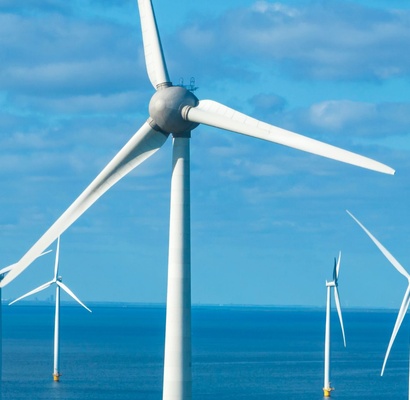
What Is an Offshore Wind Project Manager?
An offshore wind project manager is a renewable-energy delivery lead responsible for planning, budgeting and delivering offshore wind work packages from contract award to energisation, coordinating WTG, foundation, array-cable and offshore-substation interfaces using NEC contract administration, Primavera P6 and CDM duty-holder governance across developer, OEM, EPC and OFTO teams in safety-critical marine environments.
Key Takeaways
-
Senior offshore wind project managers earn £70,000-£95,000 permanent base in 2026, with major-EPC package managers advertised up to £99,100 plus car and bonus (Boskalis Aberdeen, Glassdoor June 2026).
-
Entry needs an engineering or construction-management degree plus PRINCE2, APM PMQ or PMP; GWO Basic Safety Training, offshore medical and sea survival are required for site or vessel-facing scope.
-
The career path runs from Graduate Project Engineer through Senior PM / Package Manager to Project Director and Programme Director, with an alternative outside-IR35 contract route from senior level.
-
UK offshore wind direct and indirect employment is scaling from circa 26,000 to roughly 69,000 by 2026, and senior delivery roles are among the hardest to fill (Global Wind Workforce Outlook, 2026).
-
Roughly 60% of offshore oil-and-gas skills transfer to offshore wind, which makes Aberdeen, the Humber and the Tyne the strongest transfer corridors into the role (Worldwide Recruitment Solutions, March 2026).
What an Offshore Wind Project Manager Actually Does
The role sits at the convergence of contract administration, marine logistics and electrical interface management. An offshore wind PM owns the package or the project end to end: from contract award through FEED, manufacture, marine campaign and energisation, into warranty handover and asset transfer. The seniority of the role determines whether ownership is one package (foundations, array cables, OSS, WTG) or the whole project programme.
The work is split across developer-side, EPC-side, OEM-side and OFTO-side roles, each with a different commercial driver. Developer PMs own the capital project. EPC PMs own the package against the developer's contract. OEM PMs own the turbine supply and installation programme. OFTO PMs own the operational transmission asset after divestment. The competencies overlap, but the commercial accountability does not.
What does an offshore wind project manager do day-to-day?
The role coordinates WTG, foundation, array-cable and offshore-substation interfaces from contract award to energisation, runs NEC contract administration, manages EVM project controls in Primavera P6, and holds CDM duty-holder governance on site or vessel-facing scope. Daily work includes interface coordination calls, vessel and weather-window tracking, Early Warning register management, and permit-to-work authorisation where named as duty-holder.
Core Responsibilities
The day-in-the-life splits across daily, weekly and monthly cadence. Each cycle protects a different cost line on the project: daily protects the marine spread, weekly protects the programme baseline, monthly protects the developer or EPC commercial position.
Daily responsibilities
-
Chair package coordination calls across WTG, foundation, array-cable and OSS interfaces to clear blockers before they hit the critical path
-
Track marine spread and weather-window status against the installation programme, and re-sequence vessels when a window closes
-
Review and action the NEC Early Warning register and issue compensation-event notifications within contract timeframes
-
Authorise daily site or vessel permits-to-work where named as duty-holder under CDM
Weekly responsibilities
-
Run project-controls and EVM reporting in Primavera P6, reconciling cost and schedule against baseline
-
Hold supplier and OEM performance reviews across concurrent packages
-
Maintain the risk register and interface register with named owners, mitigations and dates
Monthly responsibilities
-
Report programme, commercial and HSE status to the developer or EPC steering level
-
Reforecast cost-to-complete and escalate contingency drawdown
-
Review CDM duty-holder compliance and marine-warranty conditions for upcoming campaigns
What's the most cost-critical part of an offshore wind PM's day?
Vessel re-sequencing on a closed weather window. Heavy-lift WTIVs cost £150,000-£250,000 a day (Crewbase, February 2026). The PM who notifies under contract, re-sequences crews and draws contingency from the marine warranty inside the first 48 hours protects the campaign budget. The PM who treats it as a generic risk-register exercise loses six-figure sums per day until the next window opens.
Qualifications and Entry Requirements
Entry into offshore wind project management runs along three tracks: graduate engineering, construction project management, and lateral transfer from oil-and-gas or marine. All three converge on the same competence stack at Senior PM level. The competence gate is not the degree; it's NEC fluency, CDM authority and GWO certification.
The standard qualification spine is an engineering or construction-management degree, a project-management qualification (PRINCE2 Foundation/Practitioner, APM PMQ, or PMP), and the GWO Basic Safety Training package plus offshore medical and sea survival for any role with site or vessel access. The Association for Project Management's Chartered Project Professional (ChPP) status is the senior-level differentiator, carrying a 10-15% salary premium against the £80,000 senior baseline.
What qualifications do you need to be an offshore wind project manager?
Most roles ask for an engineering or construction-management degree plus a project-management qualification (PRINCE2, APM PMQ or PMP), with GWO Basic Safety Training, offshore medical and sea survival required for site or vessel-facing scope. Chartered Project Professional (ChPP) via APM is the senior-level differentiator. NEC3/NEC4 contract administration and CDM Regulations 2015 duty-holder competence are the gating commercial requirements at Senior PM level.
Can you become an offshore wind project manager without an engineering degree?
Yes, through the construction project-management track or lateral transfer from marine or offshore oil-and-gas. The competence requirements at Senior PM level are NEC, CDM, P6 and GWO, not the degree itself. Roughly 60% of offshore oil-and-gas skills transfer to offshore wind, which makes the lateral route a credible entry path with a structured 90-day onboarding plan closing the wind-specific gaps.
Career Path Progression
The career runs four to five stages, with an alternative contract route from senior level. The salary bands below carry through every UK region with regional weighting per the LSP Renewables 2026 benchmark (Boskalis Aberdeen advertised £66,100-£99,100 plus car and bonus, Glassdoor June 2026; SPR EA2 senior contracts inside IR35 via umbrella, Jobsite February 2026). Our salary benchmarking method covers permanent, inside-IR35 and outside-IR35 on a like-for-like total cost basis.
Assistant / Graduate Project Engineer (0-3 years, £30,000-£48,000). Entry tier. Supports a project or package manager on document control, scheduling and supplier coordination. Transition to PM requires the first owned work package, plus P6 and NEC familiarity.
Project Manager, package support (3-6 years, £50,000-£68,000). First owned work package on an offshore wind project. Transition to Senior PM requires full package ownership through energisation, NEC and P6 competence at delivery level, and GWO Basic Safety Training.
Senior Project Manager / Package Manager (6-10 years, £70,000-£95,000). Full package ownership through energisation, with CDM duty-holder competence and NEC4 commercial close-out authority. The senior tier where contract and permanent routes split.
Lead Package Manager / Project Director (10-15 years, £95,000-£135,000). Multi-package or portfolio accountability, commercial close-out authority with personal delegation up to £m thresholds, and P&L responsibility for the project.
Programme / Project Delivery Director (15+ years, £130,000-£175,000+). P&L and multi-project leadership, often holding APM Chartered Project Professional status. Typically operates above the package layer, owning the developer or EPC's UK offshore programme.
Alternative path: contract package manager from the Senior PM stage onwards. Moves project-to-project at outside-IR35 day rates (£600-£900/day standard, £900-£1,100/day for HVDC and floating-wind specialists) rather than up a single employer ladder. Visible in 2026 as the dominant senior route on EPC and OEM packages.
How long does it take to reach Senior PM in offshore wind?
Six to ten years from graduate entry, with the transition to Senior PM tied to first full-package ownership through energisation rather than years of service. Lateral entrants from oil-and-gas or marine commonly reach Senior PM faster, often inside 3-5 years of joining offshore wind, because the underlying large-capital delivery skills transfer with a 90-day onboarding closing wind-specific gaps.
Offshore Wind Project Manager vs Other Roles
Two title comparisons get conflated more than any others. Both turn on the scope and the commercial accountability, not on the seniority.
Offshore Wind Project Manager vs Offshore Wind Package Manager
Both own offshore scope, NEC commercials and interface risk from award to handover. The PM typically owns a project or multiple packages end to end on the developer or EPC side. The Package Manager owns one discipline package (array cables, foundations, OSS or WTG) in depth. The litmus test is simple: did the candidate own the whole project programme to energisation, or one package within it?
The two roles share competence requirements (NEC, P6, CDM, GWO), but the Package Manager carries deeper supplier and OEM commercial exposure within their discipline. The PM carries broader interface and stakeholder exposure across discipline boundaries. Hiring managers who brief on title rather than scope routinely shortlist the wrong tier.
Offshore Wind Project Manager vs Transmission Project Director
Both deliver large electrical infrastructure with grid-connection responsibility and NEC governance. The offshore PM works marine spreads, vessels and offshore packages. The transmission director works onshore HV substations and overhead lines. The litmus test: has the candidate managed an installation vessel campaign offshore, or energised a 400kV onshore substation?
The transmission director route sits inside the broader transmission and grid recruitment market, which overlaps at the developer's substation interface but diverges at the marine boundary. The 60% oil-and-gas skills transfer narrative applies to offshore wind PM; the transmission director route draws more from National Grid and DNO heritage.
Where Offshore Wind Project Managers Work
UK offshore wind PM roles concentrate in three corridors: East Anglia, the Humber and Scotland. Each corridor anchors on a different commercial centre and a different project pipeline.
East Anglia anchors on the ScottishPower Renewables base at Lowestoft (Hamilton Dock, PowerPark, Lowestoft Eastern Energy Facility) and the Peel Ports pre-assembly port at Great Yarmouth. East Anglia ONE/TWO/THREE drives PM demand on a single-developer model. East Anglia TWO (960MW) enters construction 2026-27; East Anglia THREE (1,372MW) is installing 115m blades manufactured at Siemens Gamesa Hull in 2026.
The Humber anchors on the Port of Hull (Siemens Gamesa blade factory, 1,000-1,100 employees, expanding 4.16 hectares to add 200 jobs), Grimsby (Ørsted East Coast Hub, world's largest offshore wind O&M base) and Immingham (Able Marine Energy Park, SeAH Wind monopile factory). The Humber workforce is mapped to grow from circa 1,700 to 10,500.
Scotland anchors on Aberdeen (ORE Catapult FLOWIC, floating-wind innovation, oil-and-gas transferee corridor), Glasgow (developer HQs at SSE Renewables and ScottishPower Renewables, Scottish Renewables Clean Energy Cluster) and the Firth of Forth and Moray Firth project corridor (Berwick Bank 4.1GW AR7 winner, Seagreen, Moray West). Scotland holds the world's largest floating-wind pipeline at 23.5GW+, with the 2040 target raised to 40GW in January 2026.
Where in the UK pays the most for an offshore wind PM?
London and the South East lead the band at £75,000-£99,100 senior and £105,000-£140,000 director, but Scotland matches at senior level (£72,000-£99,100), driven by Aberdeen's floating-wind premium and the oil-and-gas transferee pool. The offshore wind sector pipeline across these corridors carries different premia: HVDC sits highest in transmission corridors; floating-wind sits highest in Scotland; OSS package experience sits highest where major EPCs concentrate.
FAQs
How much does an offshore wind project manager earn in 2026?
Senior offshore wind project managers earn £70,000-£95,000 permanent base in 2026, with major-EPC package managers advertised up to £99,100 plus car and bonus (Boskalis Aberdeen, Glassdoor June 2026). Outside-IR35 contract rates run £600-£900/day standard, £900-£1,100/day for HVDC and floating-wind specialists. Inside-IR35 senior contracts anchor at £550-£800/day via umbrella with BPSS clearance.
Is offshore wind project management a good career in 2026?
Demand is strong and rising. UK offshore wind employment is scaling toward 69,000 by 2026, AR7 awarded a record 8.4GW in January 2026, and 61% of clean-energy firms have raised salaries every year since 2023 (Astute Renewable Energy Salary Guide 2025). Senior delivery roles are among the hardest to fill, which keeps the negotiation power with the candidate.
Can an oil and gas project manager move into offshore wind?
Yes. Around 60% of offshore oil-and-gas skills transfer to offshore wind, and employers actively target O&G, marine and construction professionals to widen a finite talent pool. The wind-specific gaps to close inside 90 days are GWO certification, balance-of-plant interface fluency, CfD commercial context and the AR7 strike-price model. Aberdeen, the Humber and the Tyne are the strongest transfer corridors.
Do offshore wind project managers work offshore or in an office?
Both, depending on the scope. PMO and consents roles are typically shore-based and hybrid 2-3 days office. Construction Manager, Installation Manager and site-facing package roles require GWO certification, offshore medical and rotational vessel time during marine campaigns. The seniority and the project phase determine the split, not the title alone.
What's the difference between contract and permanent offshore wind PM work?
Permanent roles offer 8-10% pension, 10-15% bonus and car allowance against an £70,000-£95,000 senior base. Inside-IR35 contracts on developer programmes run £550-£800/day via umbrella with BPSS clearance. Outside-IR35 contracts run £600-£900/day, with HVDC and floating-wind specialists higher. Contract is growing faster at senior and package level in 2026.
Plan your next offshore wind PM move
If you're scoping a step up to Senior PM, weighing a contract switch or sizing the move from oil-and-gas into offshore wind, the LSP CV guide walks the positioning before the conversation. We benchmark live every week from active placements across the UK offshore wind pipeline.