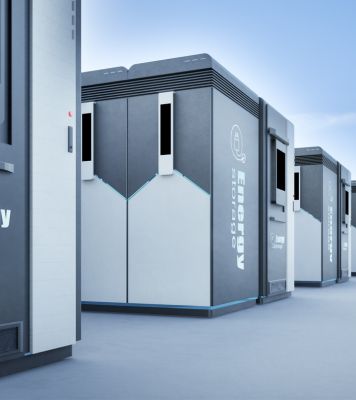
The European energy storage market continues to strengthen, with utility-scale battery projects now firmly leading growth. Last week's Intersolar Europe / ees Europe exhibition in Munich reinforced that battery storage has moved from being an adjacent technology to becoming central to Europe's energy transition.
Market sentiment: Positive, despite a more cautious outlook for the solar manufacturing sector.
Key themes were:
• Utility-scale BESS remains the fastest-growing segment
• Co-located solar + storage is becoming the preferred development model
• Grid-forming technology is moving into commercial deployment
• AI, data centres and industrial loads are emerging as major new demand drivers
• Software and energy management systems are becoming as important as battery hardware
UK Market
The UK remains one of Europe's three largest battery storage markets, alongside Germany and Italy, with developers continuing to progress both standalone BESS and hybrid renewable projects. Europe's largest markets remain attractive because of mature ancillary services, increasingly sophisticated revenue stacking and supportive market structures.
Major trends
1. Revenue stacking continues to evolve
2. Longer duration systems gaining traction
3. Grid connection remains a challenge
European Market
The headline statistic announced during Intersolar was that Europe installed a record 36 GWh of battery storage in 2025, a 48% year-on-year increase, pushing cumulative installed capacity beyond 100 GWh for the first time. Utility-scale storage accounted for more than half of annual installations.
SolarPower Europe forecasts annual installations could exceed 50 GWh in 2026 and continue accelerating towards 2030 if permitting and market reforms continue.
Fastest growing markets
Traditional leaders remain:
• Germany
• UK
• Italy
However, a notable development is the rapid emergence of:
• Ukraine
• Bulgaria
as significant storage markets, reflecting both energy security needs and renewable integration.
Key Takeaways from Intersolar Europe / ees Europe (Munich)
1. Storage has become the centrepiece
2. Hybrid systems dominate
3. Grid-forming technology is moving mainstream
4. Co-location is becoming standard
5. AI and data centres are creating new demand
6. Software is becoming the differentiator
What to Watch in H2 2026
• Continued growth of utility-scale BESS across Europe.
• Greater deployment of hybrid solar-plus-storage projects.
• Increased adoption of grid-forming inverters and advanced power electronics.
• Expansion of storage solutions for commercial, industrial and data centre applications.
• Greater emphasis on software, optimisation platforms and virtual power plant participation as key value drivers
Get in touch: Sam.warnett@lsprenewables.com