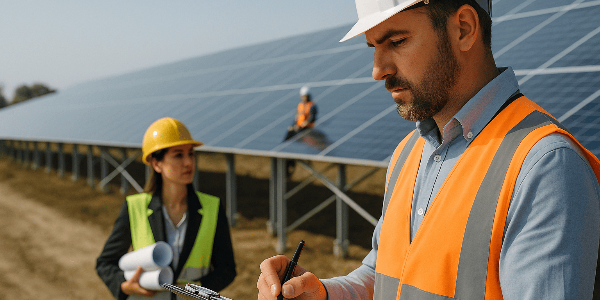
Finding civil engineers with the specific technical expertise to manage site grading, drainage, and foundation design for utility-scale solar is a challenge. Generalist engineers often lack the nuanced understanding of photovoltaic (PV) array loads and ground-mounted structural tolerances required for large-scale developments.
EPC contractors and engineering managers face significant risks when the civil team cannot accurately predict soil behaviour or optimise cut-and-fill balances for solar trackers. We connect you with verified experts who understand that a solar farm is not just a construction site, but a precise power generation asset requiring exact geotechnical stability.
-
Specialised Focus: Solar civil engineers must master site grading, hydrology, and piling specifically for ground-mounted PV arrays.
-
Risk Mitigation: Hiring specialists prevents costly post-construction settlement and tracker misalignment issues.
-
Flexible Talent: We supply both contract staff for peak construction phases and permanent technical leads for long-term project planning.
-
Global Reach: Access candidates with proven delivery records on 50MW+ projects across the UK and international markets.
Why Utility-Scale Solar Projects Need Specialist Civil Engineers
Standard civil engineering principles often fail when applied to the unique load-bearing and topographic demands of a 50MW+ solar array. A specialist understands how to design earthworks that accommodate thousands of piles while minimising environmental impact and material movement costs.
Why are site grading and earthworks critical for solar farms?
Site grading ensures the land topography meets the specific slope tolerances required for tracker movement and water runoff without excessive earth movement. In our experience, client testimonials often highlight that generalist engineers over-engineer the grading, leading to inflated costs, or under-engineer it, causing drainage failures. A solar-focused civil engineer uses software like Civil 3D to model the exact cut-and-fill balance needed for the specific racking system chosen, ensuring the site is optimised for both construction speed and long-term operational efficiency.
How do foundation and piling designs differ for PV arrays?
PV array foundations require specific piling depths and pull-out resistance calculations based on wind uplift and local hydrology. Unlike standard building foundations, solar piles must withstand dynamic wind loads across a vast, often uneven surface area. We source engineers who can interpret geotechnical reports to determine the exact pile driving requirements, preventing the "refusal" issues that stall mechanical installation teams. This technical precision is vital for maintaining the structural integrity of the entire array over its 25-year lifespan.
How EPC Contractors Hire Solar Civil Engineers Faster
Our recruitment process cuts time-to-hire by focusing on technical pre-qualification and verified industry experience. We don't just send CVs; we build workforce strategies that align with your project's critical path.
1. Defining Contract vs Permanent Requirements Contract vs Permanent Workforce Planning:
We analyse your project pipeline to determine if a contract engineer is best for immediate site-specific challenges or if a permanent hire is needed to lead the department. Many EPCs benefit from hiring contract engineers for the intensive Design & Civil Works phase, ensuring you have high-level expertise during ground-breaking without increasing fixed overheads during the O&M phase.
2. Leveraging UK and International Experience Global Talent Sourcing:
We tap into our network of engineers with proven UK and international solar project experience to find candidates familiar with specific grid codes and environmental regulations. An engineer who has delivered a 100MW project in Spain or Australia brings valuable insights into managing difficult terrain and logistics that can be applied to UK sites. This cross-market knowledge transfer helps your team anticipate and solve site conditions that might otherwise delay the build.
3. Validating Technical Competency Portfolio & Software Screening:
We rigorously assess every candidate’s portfolio for specific utility-scale deliverables, such as drainage strategies for large catchment areas and road layouts for heavy plant access. We ensure they are proficient in industry-standard design tools and have a track record of coordinating with electrical and mechanical teams to avoid clashes during the build.
Common Risks of Hiring Non-Specialist Civil Engineers
Placing a generalist civil engineer on a utility-scale solar project frequently results in design oversights that only become apparent during construction. We often see issues where access roads are not designed to support the specific turning circles of delivery trucks carrying long PV components, or where drainage designs fail to account for the increased runoff coefficient of the panels. These errors lead to retroactive fixes, machinery downtime, and significant budget overruns. Partnering with a specialist recruiter ensures you Submit A Vacancy for candidates who have already solved these problems on previous utility-scale sites.
Frequently Asked Questions
What does a solar civil engineer do on a utility-scale project?
A solar civil engineer designs and oversees site grading, drainage, access roads, and foundations to ensure solar farms meet structural and environmental requirements. They coordinate with geotechnical experts to validate ground conditions for piling and ensure all earthworks support the efficient installation of racking systems.
Why is solar experience important for civil engineers?
Solar-specific experience ensures engineers understand panel loading, soil conditions, and long-term asset stability unique to utility-scale PV sites. Without this niche knowledge, engineers may miscalculate wind uplift effects on trackers or fail to design drainage that accommodates the large surface area of the array.
Do EPC contractors hire solar civil engineers on contract or permanent basis?
EPC contractors use both contract and permanent solar civil engineers depending on project phase, build timelines, and pipeline certainty. Contractors are often used for peak design and construction periods, while permanent staff manage long-term portfolio engineering and standardisation across multiple sites.
Ready to Build Your Civil Engineering Team?
Secure the technical expertise required to de-risk your next utility-scale solar project by contacting our specialist recruitment team today.